I Stayed up at the bar a few times but I didn’t want the barman thinking that I needed someone to talk to.
Roddy Doyle’s Smile Page 1, Line 1. Penguin Random House
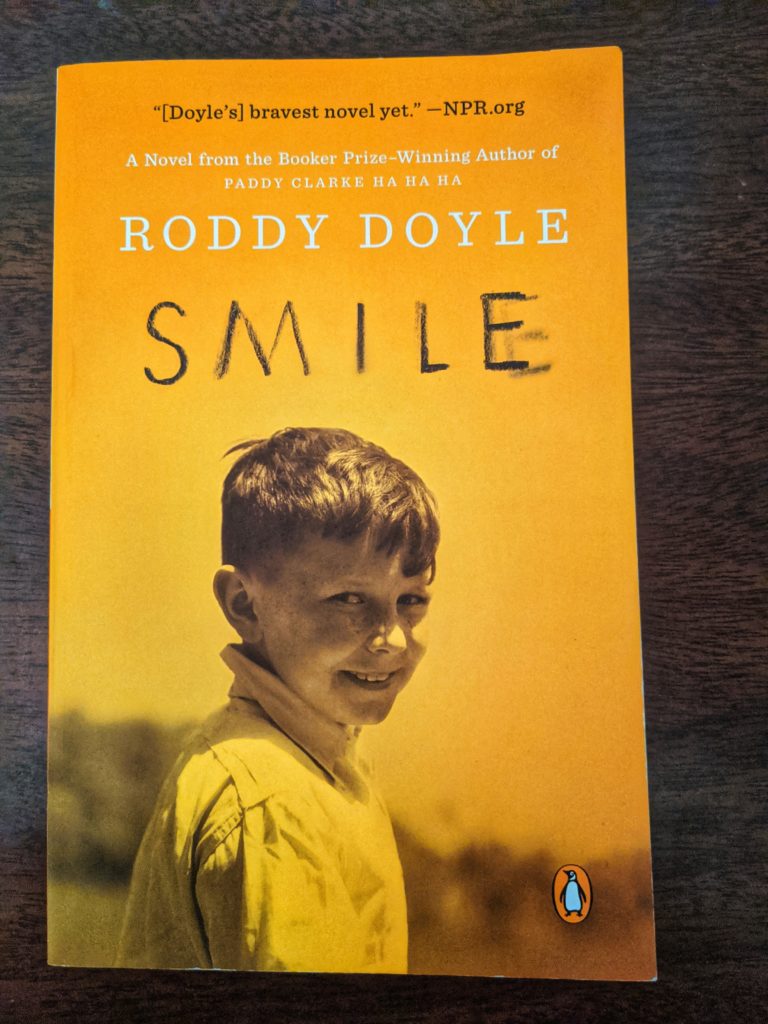
This first line tells us a lot about our main character (Victor). The obvious is that our character is old enough to drink which generally implies they are an adult. “I didn’t want the bar man thinking…” the main character is viewing himself through an outsider’s perspective, a barman. He (Victor) is worried about what the bartender thinks of him, which doesn’t scream confidence. He is afraid that he looks like he “needed someone to talk to”, and he probably does need someone to talk to.
Let’s just finish up the whole first paragraph, why not? It’s short. “I sat in a corner near a window but the barman kept coming over, casually walking past…”. The barman makes himself look busy, makes small talk, and makes sure our character is alright…for a beer, of course. This really gives me the impression the bartender was trying to get our character to open up and spill whatever was on his mind, maybe he was concerned. Let’s skip to the last few lines here…
I tried to picture myself from where he’d been looking at me. I can’t have looked that bad – that lonely, or sad. Or neglected. It never occurred to me that he might be gay. I was fifty-four. I was too old to be gay back.
Roddy Doyle’s Smile Page 1, Line 1. Penguin Random House
“I can’t have looked that bad- lonely, or sad. Or neglected.” Emphasis mine this time because Victor isn’t saying that he didn’t look lonely, or sad, or neglected. He admits that he probably does look all those things, but not that much. What is that much, anyway? Any amount of those emotions certainly warrants someone to be allowed to talk about it, but our character can’t allow himself too. Instead he is worrying about what he looks like to others and seems to think of himself as a nuisance. “I was too old to be gay back” also strikes me as a bit, out of place maybe. I don’t think he is necessarily saying that he is too old to “try” being gay, rather I think he saying he is too old to love someone back. Ouch, rough, right?
These themes of self doubt, unease, and self-deprecation do not let up in this book. Any single point that Victor appears to finally have some semblance of happiness is generally taken away from someone else, usually in the form of memory though, as if he can’t allow himself to be happy, it just isn’t in him anymore after years of being broken down again and again.
Victor may have grown up in 70’s/80’s Ireland, but for anyone that has dealt with a lack of confidence and belonging (which is everyone, right?) this story feels like it could be ours as well and by the end you’ll want to join Victor for a beer in the corner of the bar.